The National Migraine Centre is a UK charity providing specialist, medically led migraine diagnosis and care. Alongside its clinical services, the centre shares educational resources to help people understand migraine and headache, recognise possible patterns and prepare for conversations with their healthcare professionals.
To explore what current research and clinical experience can tell us about weather sensitivity, Weathera invited Dr Surangi Mendis, Headache Specialist at the National Migraine Centre, to share her perspective. Dr Mendis is also a consultant audiovestibular physician with experience in the diagnosis and management of vestibular migraine, dizziness and balance disorders.
In this written interview, Dr Mendis discusses weather as a possible contributing factor in migraine, the evidence surrounding atmospheric pressure and extreme heat, and the way environmental changes may interact with sleep, stress, hydration and other influences. She also explains why symptoms can appear before an obvious change in weather, and how a structured diary can help people look for patterns without assuming that one factor explains every attack.
We thank Dr Surangi Mendis for sharing her time, clinical perspective and research-informed answers, and the National Migraine Centre for its work supporting people affected by migraine. We encourage readers to explore the centre’s work and educational resources through its official website.
Key takeaways
Weather can contribute to migraine attacks in some people, but it is not a universal trigger or the cause of migraine.
Barometric pressure, temperature and sunlight may matter, and responses to weather changes vary between individuals.
Weather may combine with poor sleep, stress, dehydration, missed meals or hormonal changes to push someone over their migraine threshold.
Symptoms before an obvious weather change may reflect subtle atmospheric changes or the early, prodromal phase of migraine.
A structured diary can help identify personal patterns. Track symptoms, weather, sleep, stress, hydration and other factors together.
Editorial summary by Weathera, based on Dr Mendis’s answers.
Dr Mendis’s introduction
A question I am sometimes asked at the National Migraine Centre (and in my NHS practice) is whether there is a basis for weather sensitivity in migraine. The answer to this is yes; but the most important point is that weather is a trigger/modulator for a subgroup of people with migraine, not a universal cause for all. And the evidence is also stronger for some weather types than others.
We often describe the migraine brain as a sensitised, biologically vulnerable nervous system. Weather doesn't necessarily ‘cause’ a migraine attack directly but in susceptible people, environmental changes can be the final trigger that pushes an already vulnerable system into an attack.
There is reasonable evidence for associations with barometric pressure, sunlight and temperature specifically - which I will talk about in further detail.
What does the current evidence tell us about weather as a possible migraine trigger?
Dr Surangi Mendis:
There is reasonably good evidence that weather changes can be associated with migraine attacks in some people, although the relationship is not consistent across everyone with migraine.
‘Weather’ is of course not one single exposure. Researchers have looked at changes in barometric (atmospheric) pressure, temperature, humidity, wind and other environmental factors. A 2025 systematic review and meta-analysis of 31 studies found significant associations between migraine attacks and weather changes for some individuals, with temperature and air pressure showing significant associations, whereas humidity did not show a significant association overall [1]. However, this does not mean that weather is a trigger for every person with migraine.
This fits with what we see clinically: some people are extremely weather-sensitive, while others notice no relationship at all. Some of my patients specifically say that they know a migraine attack is more likely to occur if there is very high or low atmospheric pressure. This is backed by evidence; an open-access study that followed people with migraine alongside detailed meteorological data found significant associations between weather variables and attacks in a subgroup of patients, rather than across the whole group [2].
So we describe weather as a possible trigger or contributing factor, rather than saying that changes in the weather directly cause migraine attacks.
Does weather act independently, or does it contribute to an overall migraine threshold alongside sleep, stress, dehydration, hormones and other factors?
Dr Surangi Mendis:
We can use the migraine threshold model again to explain this, rather than thinking about individual triggers in isolation.
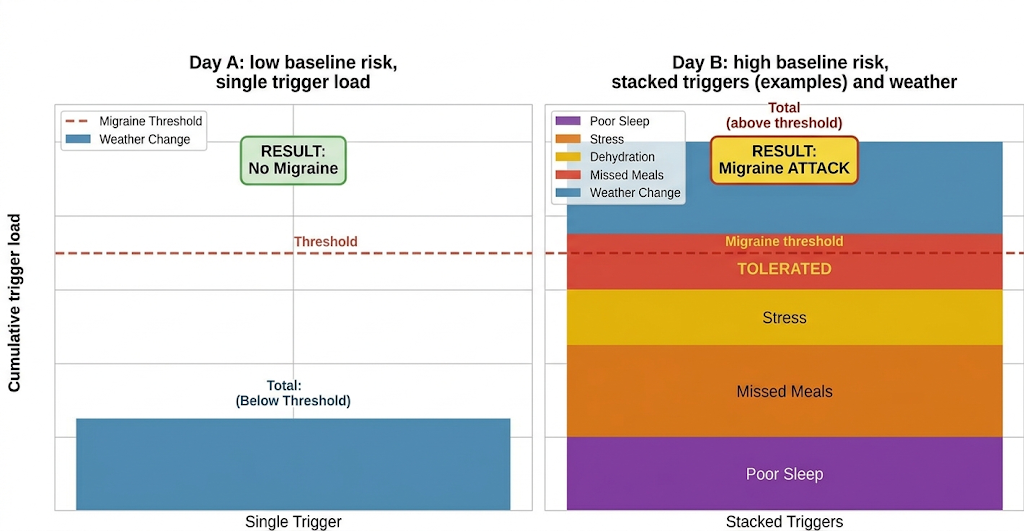
The brain in migraine is particularly sensitive to internal and external changes. A person might tolerate a change in weather on one day without developing an attack, but the same weather change might be enough to precipitate an attack when they are already closer to their threshold because they have had poor sleep, missed meals, become dehydrated, are under significant stress or are experiencing hormonal fluctuations, e.g. figure 1.
Figure 1: The ‘Migraine Threshold’ model.
In other words, a change in atmospheric pressure may not independently cause a migraine attack. However, if someone’s migraine threshold is reached, or lowered, because of factors such as poor sleep, stress, dehydration or hormonal changes, a change in weather may be one additional factor that pushes them over that threshold and precipitates an attack.
This is an important concept because it also explains why a person may not experience an attack every time the weather changes.
This threshold theory is increasingly used to understand migraine as the interaction of multiple internal and external factors rather than a condition which has one simple trigger.
There is good observational evidence that people report a number of potential precipitants — including stress, hormonal changes, sleep disturbance, not eating and weather — and these can occur together rather than independently.
It is also important to distinguish triggers from causes. Weather does not cause the underlying neurological disorder. It may be one of several environmental factors that can precipitate an attack in a person who is already genetically susceptible to migraine.
I wish to talk specifically about barometric (air) pressure changes and heatwaves and extreme heat as these are the two specific weather types which have the strongest association with migraine attacks.
Air/barometric pressure
This is probably the one people ask us at the National Migraine Centre about most.
What is the evidence? There is evidence that changes in atmospheric pressure, particularly falling pressure, can be associated with migraine attacks — but the relationship isn't as simple as ‘low pressure = a migraine attack’.
A prospective study of 28 people with migraine found that migraine frequency increased when pressure fell by more than 5 hPa from one day to the next; 18/28 participants had an association between weather change and migraine, with 14 specifically reporting low pressure as a trigger [3].
But it’s not quite that straightforward - as other studies have found different relationships. An older study of 44 people, for example, actually found lower migraine frequency at lower pressure [4].
A recent systematic review concluded that the literature overall is heterogeneous and inconsistent, particularly regarding whether pressure needs to fall or rise to trigger symptoms [5].
So we can conclude from the evidence, and from what we hear anecdotally from our patients, that changes in atmospheric pressure appear to trigger or worsen migraine in some people, but the direction and magnitude of the effect vary considerably between individuals.
But how exactly does pressure affect the brain to result in a migraine attack? One hypothesis is that rapid pressure changes alter mechanical forces in tissues containing air — including the middle ear, sinuses and other cranial structures — which could provide sensory input to the trigeminal system.
But there is also experimental evidence suggesting it may be more directly neurological than simply ‘sinus pressure’. In an animal study, researchers experimentally lowered atmospheric pressure by 40 hPa and found increased activity in neurons in the spinal trigeminal nucleus, particularly neurons receiving input from the eye/corneal region [6].
We think the migraine brain may be unusually sensitive to changes in its environment. Experimental work suggests that changes in atmospheric pressure can activate pathways within the trigeminal system - with release of neuropeptides such as CGRP and subsequent pain signalling - which is one of the major pain pathways involved in migraine.
Heatwaves / extreme heat
This is another area where we see a clear link between weather and migraine and with this factor there are likely several biological mechanisms acting simultaneously.
Recent observational research from the University of Cincinnati analysed over 70,000 daily headache diary entries from 660 people with migraine alongside local meteorological data. Presented at the 2024 American Headache Society meeting, the study reported approximately a 6% increase in headache occurrence for every 10°F (5.6°C) increase in outdoor temperature [7]. While this is emerging evidence rather than long-established clinical guidance, it mirrors what many patients experience during hot spells.
However, heat itself may not be the entire story. In practice, high temperatures frequently act as a compound trigger: Firstly, heat directly promotes sweating, leading to loss of water, sodium and electrolytes. Dehydration is a well-recognised physiological stressor that lowers the threshold for an attack. Secondly, heatwaves frequently cause warmer nights, leading to fragmented, poorer-quality sleep and disrupted regular daily routines, both of which are strong, independent migraine precipitants. And finally, there is a neurobiological link involving thermoregulation. The hypothalamus - the brain's control centre for regulating body temperature, thirst, hunger, sleep, and autonomic function - is implicated in the early phase of a migraine attack. Studies have identified temperature-sensitive molecular channels within trigeminal pain pathways, providing a potential direct link between temperature shifts and neurovascular pain signalling [8].
Ultimately, extreme heat places the body under physiological stress. Because the migraine brain is exceptionally sensitive to shifts in internal balance, a heatwave rarely acts alone; it simultaneously stacks dehydration, sleep disruption, thermoregulatory strain and bright sunlight onto a patient's baseline risk to push them over the migraine threshold.
Why do some people report migraine symptoms before an obvious weather change?
Dr Surangi Mendis:
This is a common clinical observation, and patients often describe feeling as though they can ‘predict’ the weather. There are two main biological explanations for this.
First, the subtle atmospheric changes associated with an incoming weather front, such as a gradual drop in barometric pressure or changes in air ionisation, begin long before visible weather changes like rain, storm clouds, or a noticeable drop in temperature occur. Because the migraine brain possesses a heightened sensitivity to sensory and environmental inputs, trigeminal pathways and central neurons may detect and respond to these microscopic pressure shifts hours before the weather event is obvious to the average person.
Second, what feels like a symptom triggered before a weather change may actually be part of the migraine attack itself. A migraine is not simply the onset of head pain; it is a complex, multi-stage neurological event. The initial phase, known as the prodrome, can begin 24 to 48 hours before the actual headache phase starts. During the prodrome, hypothalamic involvement can cause subtle changes in perception, mood, cognitive function, and sensory processing. This altered sensory processing can make a person temporarily hyper-aware of environmental shifts or cause them to perceive normal background weather changes as oppressive or uncomfortable. In some cases, environmental sensitivity is a premonitory symptom of an attack that has already begun in the brain, rather than the external trigger that started it.
How can patients track possible patterns without assuming causation too quickly?
Dr Surangi Mendis:
It is very natural to look for a single cause when experiencing a disabling migraine attack, but assuming causation too quickly can lead to unnecessary anxiety or overly restrictive lifestyle habits. Helping our patients track patterns objectively is a key part of management at the National Migraine Centre.
If looking specifically at weather changes (rather than tracking only the number of migraine days for the purpose of reporting back to a headache service after starting a new medication), I recommend using a detailed, structured prospective headache diary over a period of around two to three months, ideally during a period of changeable weather such as spring or autumn. Our NMC diary is freely accessible to all: https://www.nationalmigrainecentre.org.uk/headache-diary/. Rather than simply noting "I had a migraine attack today on a rainy day," the diary should capture multiple variables simultaneously. Aim to log the onset, severity, and duration of symptoms alongside potential internal baseline factors, such as sleep duration and quality, stress levels, hydration, meal timing, and hormonal status (such as days of the menstrual cycle), as well as notable weather shifts.
By tracking these factors together, one can look for true patterns of trigger stacking rather than isolated culprits. It often shows us that a weather change only correlates with an attack when it coincides with poor sleep or high stress, reinforcing the threshold model.
It is also important to watch out for confirmation bias; the human tendency to remember the times a weather change was followed by a migraine, while forgetting the days the weather changed and no attack occurred, or the days an attack happened during perfectly stable weather. Tracking provides some objective clarity, helping those with migraine avoid unnecessarily avoiding outdoor activities or feeling powerless against the forecast.
What are practical ways people may prepare when they regularly notice weather-associated migraine symptoms?
Dr Surangi Mendis:
Because we obviously cannot control the weather, management focuses on controlling the internal variables that we can influence, thereby keeping the baseline trigger load as low as possible.
When a person knows a weather front, pressure drop, or heatwave is expected, the most effective strategy is to proactively optimise all other components of their migraine threshold:
Maintain routine stability: The migraine brain thrives on consistency (regularity in sleep, meals, and hydration) and does not like change. During anticipated weather shifts, keeping sleep and wake times consistent, and stress levels as low as possible, helps keep the nervous system calm.
Prioritise hydration: Ahead of hot weather particularly, increasing fluid intake helps prevent dehydration from stacking onto environmental stress.
Protect against secondary environmental triggers: During sunny or hot weather, simple measures like wearing polarised sunglasses, staying in air-conditioned environments, or avoiding peak sunlight hours reduce sensory overload. For people who are especially light sensitive, we sometimes suggest they try tinted lenses designed specifically for migraine sensitivity, e.g. FL-41 is a rose-tinted filter that blocks blue-green light frequencies known to trigger migraine - brands such as TheraSpecs or Avulux offer prescription and non-prescription models that combine light-filtering tints with glare protection.
Manage acute stress levels: Knowing that a weather change is coming can sometimes induce anxiety, which ironically raises the baseline trigger load. Engaging in relaxation techniques or reducing optional demands during high-risk weather windows can protect the brain's threshold.
Optimise preventive treatments: For individuals with significant, frequent disability during certain seasons or weather conditions, discussing optimised preventive treatment OR lifestyle-based, or acute treatments used early at the onset of prodromal symptoms, with their clinician ensures the brain's baseline sensitivity is kept as low as possible. As the UK’s only charity providing specialist, medically led migraine diagnosis and care, the National Migraine Centre offers a unique, personalised service accessible to anyone living in the UK to be able to discuss these options where appropriate.
In summary, my key takeaway: For some people with migraine, weather really can be a trigger — but it isn't as simple as saying that low pressure or hot weather causes migraine. The migraine brain is a particularly sensitive nervous system, and changes in pressure, temperature, light and other environmental factors can interact with other triggers and push someone over their individual migraine threshold. Weather, particularly atmospheric pressure changes, strong sunlight or extreme heat, is often one additional trigger rather than the whole explanation.
Explore your local weather with Weathera
Check your local forecast and compare weather changes with your symptom diary over time.
Dr Surangi Mendis is a Headache Specialist at the National Migraine Centre and a Consultant Audiovestibular Physician. Her clinical experience includes the diagnosis and management of vestibular migraine, dizziness and balance disorders.
Li S, Liu Q, Ma M, Fang J, He L. Association between weather conditions and migraine: a systematic review and meta-analysis. J Neurol. 2025 Apr 17;272(5):346. doi: 10.1007/s00415-025-13078-0. PMID: 40246758.
Cull, R.E. (1981), Barometric Pressure and Other Factors in Migraine. Headache: The Journal of Head and Face Pain, 21: 102-104. https://doi.org/10.1111/j.1526-4610.1981.hed2103102.x
Farah A, Adam Y, Ahmed O, Ahmed RAO, Ali Mohammed MA, Ahmed RAA, Abdelrahman IMO, Mohamed Elamir A, Ahmed AAA, Elnosh H. Impact of Barometric Pressure Changes on the Severity, Frequency, and Duration of Migraine Attacks: A Systematic Review of the Literature. Cureus. 2025 Nov 14;17(11):e96821. doi: 10.7759/cureus.96821. PMID: 41245912; PMCID: PMC12617017.
Messlinger K, Funakubo M, Sato J, Mizumura K. Increases in neuronal activity in rat spinal trigeminal nucleus following changes in barometric pressure--relevance for weather-associated headaches? Headache. 2010 Oct;50(9):1449-63. doi: 10.1111/j.1526-4610.2010.01716.x. PMID: 20561066.
Treatment With Fremanezumab Attenuates the Association Between Weather and Headache in Participants With Episodic Migraine: a Post-Hoc Analysis of the HALO-EM Study (P9-12.002) | Neurology